4279044 Signalman William "Bill" Carr
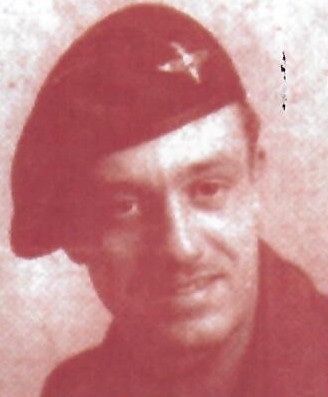
4279044 Signalman William ‘Bill’ Carr was born on June 19, 1922.
He successfully completed parachute course 93 held at Ringway, near
Manchester, from 29th November to 13th December 1943.
Bill was part of a three-man team from K Section Signals
attached to 11th Parachute Battalion.
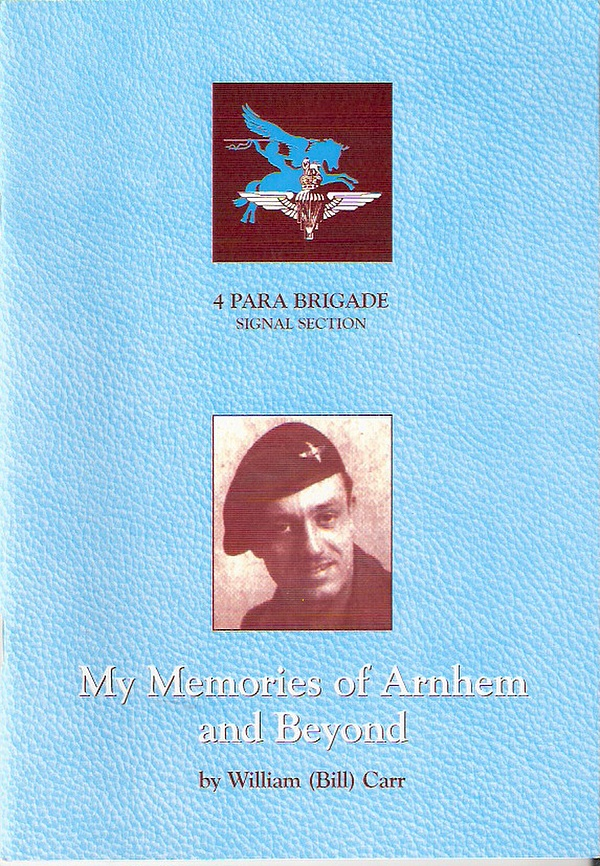 After his release from Prisoner of War, Bill wrote down his experiences and published them in a
booklet called "My Memories of Arnhem and Beyond."
After his release from Prisoner of War, Bill wrote down his experiences and published them in a
booklet called "My Memories of Arnhem and Beyond."
On Monday September 18, 1944 he embarked for Arnhem from an airfield in Lincolnshire.
Bill had an eventful flight and an even more eventful parachute drop on drop zone Y at Ginkel Heath.
While running
towards the rendezvous point (RV-point) he was struggling with the wireless set on his back. He was also carrying
two heavy batteries, the aerial and all the ancillary equipment. He thought back to the occasion a few months
previously, when he had demonstrated the 22 wireless set to King George VI:
"In answer to his question, I told the King that it required three men to carry all the necessary equipment."
Now he was having to manage alone.
Arriving at
the RV-point, the wireless set frequencies were preset by a crystal. To Bill’s utter disgust he found that the
crystal had been left in the breast pocket of his wounded colleague meaning the wireless set was virtually useless.
So,
Bill joined up with an infantry platoon and set off with the battalion towards Arnhem.
When the battalion stopped at
the Divisional Headquarters Bill jumped into a fox-hole. Inside was a ginger-haired fellow smoking a cigarette and
writing notes. He told me he was a War Correspondent for the Daily Express. It was
Alan Wood.
The battalion set off
again towards Arnhem to push through the following day to the road bridge to relieve Colonel Frost and his men.
Despite the utmost efforts and fierce fighting of the four battalions (2nd Battalion The South Staffordshire
Regiment, 1st, 3rd and 11th Parachute Battalions) to push through to the bridge in Arnhem, they failed against a
German force that was far too strong for them.
The 11th Battalion first withdrew to the Lombok district, west of St.
Elisabeth Hospital. It was a losing battle; the German superiority was too much, and eventually 150 of the more than
600 men withdrew to Oosterbeek. The rest were captured, wounded, or killed.
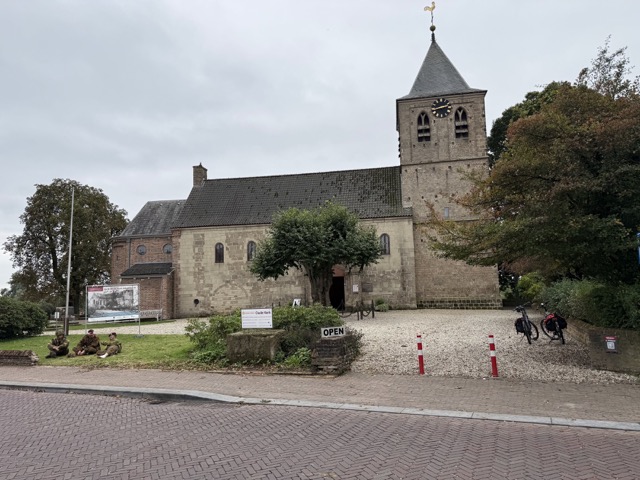 The men arrived eventually to a tight
perimeter around Oosterbeek old church, which was serving as the headquarters for ‘Lonsdale Force’. Made up of
remnants of different battalions. Typical of the spirit with which the tanks were resisted was a fellow from Bill’s
section with his left arm in a sling and a Sten gun tucked under his right arm firing at the turret of a tank and
laughing as he did so.
The men arrived eventually to a tight
perimeter around Oosterbeek old church, which was serving as the headquarters for ‘Lonsdale Force’. Made up of
remnants of different battalions. Typical of the spirit with which the tanks were resisted was a fellow from Bill’s
section with his left arm in a sling and a Sten gun tucked under his right arm firing at the turret of a tank and
laughing as he did so.
During one of the many patrols Bill participated in he was in a fox-hole with another pal
from his Signal section when a mortar bomb landed on the other side of his friend. His friend sustained terrible
injuries, but his body had sheltered Bill from the effects of the explosion. Bill treated his friends’ wounds and
gave him a morphine injection. Bill tried to apply a splint to his friend's leg, but was hit in the left side by a
piece of shrapnel. It was a small wound, but it bled freely. His lieutenant, who was wounded himself, gave Bill the
order to get back to the dressing station and get stretcher bearers. So he did.
Bill went into the house of Kate ter
Horst, but it was full of very badly wounded troops, so he went outside to a large building which was the concert
hall.
On Monday September 25, Bill was informed that a planned evacuation was to take place that coming night. The
walking wounded were to make their way down to the river bank, where boats would ferry them across to the south
shore. Bill could not escape the thought that the general reaction was a mixture of acute disappointment that their
efforts of the past nine days had all been in vain.
Bill managed to hide under the stage amid the confusion, and
when the opportunity came:
I crawled out into the darkness.
Bill almost stumbled over a German soldier and could see
that his foot had been blown off. The German was moaning in agony and pleading for help. Bill lifted him up and put
him over his shoulder. Bill intended to carry him to a nearby house, dress his wound and leave him. However, when he
got to a house he was confronted by two German soldiers with rifles and fixed bayonets.
They took Bill and his
wounded German to their headquarters and there he was interviewed by a panel of officers.
On Monday September 25th 1944 Bill became a prisoner of
war. He and many others had to walk towards Arnhem railway station and they were herded
onto a train; destination Germany. When they arrived at their destination they were marched a distance of about two miles
to prisoner of war camp Stalag XIIA at Limburg, Germany, in total darkness.
After one month Bill was transferred to
another camp Stalag IVB at Mühlberg.
In early 1945 he and a group of others were brought to the city of Dresden
for clearing of bomb debris.
From Signalman Carr's General Questionnaire for British/American Ex-Prisoner of War: 14th May 1945
DOB: 19-6-1922
Date of Enlistment: 16 Nov 1945
Trade: Clerk
Address: 10 Union Street, Newcastle Upon Tyne, Northumberland.
Captured: Arnhem
Wounded: Yes
Camps/Hospitals: 12A Limburg Sept - Oct; 4B Mulberg Oct – Nov;
Working in Camp: Dresden Nov until April 45 Clearance of bomb debris.
Escapes attempted:
From working camp in Dresden with Pvt D Jewers. Recaptured after 3 days near Norse in woods by police in May. Again
in April from Tyssa with Pvt R. O’Dwyer and Pvt L Norton of Para Regt. Made way to Russian lines near Chamnitz where
heard war was over on wireless. Made way then to Americans.
In April 1945 he was liberated and returned to the UK.
Bill died on February 4, 1988,
aged 75.