5110007 Lance Corporal Harold Cook
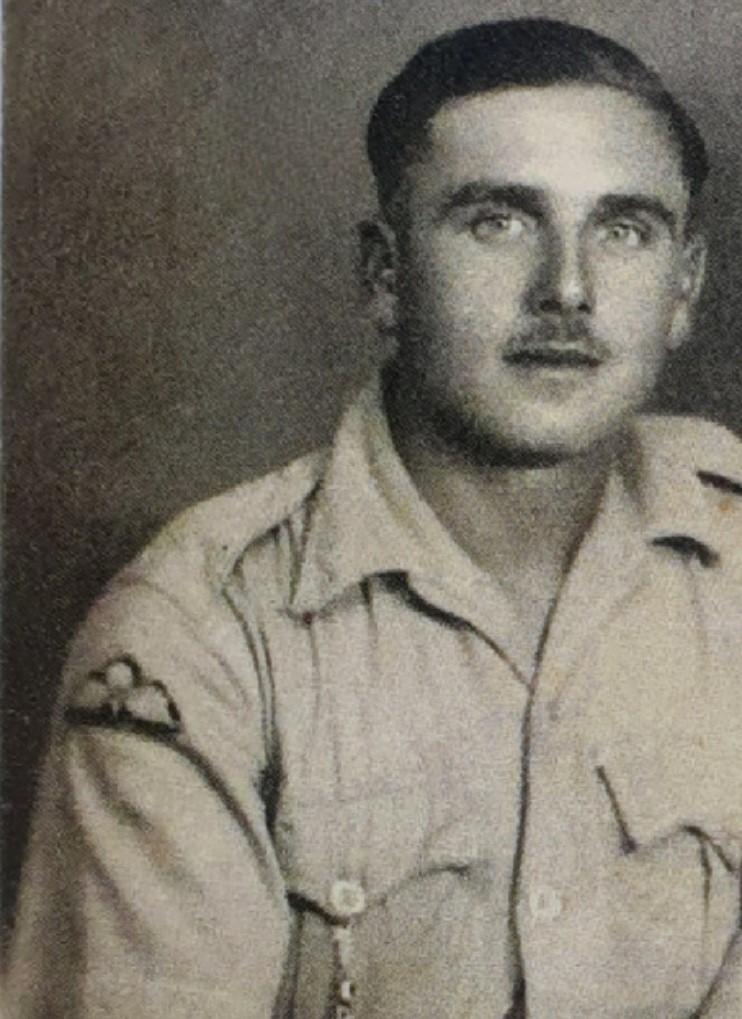
5110007 Lance Corporal Harold Cook was born in May 20, 1919, he was the son of Frank and Leah Cook and was born in
Sheffield.
During his teenage years he worked as a butcher’s assistant after school and during the weekends.
As soon
as he completed school Harold joined the armed forces in November 1936 at the age of 17. He lied on his enrolment
form, stating he was born in 1918 and joined the Royal Warwickshire Regiment.
From 1938 to 1942 he was stationed in
India where he completed his signals course. In 1942 he joined the Parachute regiment, undertaking his parachute
course R156 at parachute school Chaklala in India.
After successfully completing his parachute course he was
assigned to 151 Parachute Battalion in India, transferrin in 1943 to the 11th Parachute Battalion as C
Company’s signaller.
In September 1943 he saw action on the island of Kos.
Then, on Monday September 18, 1944, Harold flew
to Holland. When they arrived at the drop zone he jumped clear of his aircraft with a kitbag containing his wireless
set. As Harold released it, the rope broke and the bag hurtled to the ground. Needless to say this was the end of
the wireless.
Harold then discovered that the other signallers had all had similar experiences with rope failure. To
compound the consequent communication difficulties, the glider carrying the signallers' jeep and spares had
overturned on landing. Without their signallers' equipment and with no jeep, Harold and the other signallers were formed into a reserve fighting
section.
After the heavy fighting in Arnhem, Harold was one of the 150 men of the 11th Battalion who retreated to
Oosterbeek near the old church.
On Wednesday evening, September 20, Harold was at the De Soet family's villa called
‘Vredehof’ with a number of comrades from the 11th Battalion. They were Privates Thomas Cunningham (HQ Coy, 11 Bn)
and Jimmy Kerr (B Coy, 11 Bn). The next day Regimental Quarter Master Sergeant (RQMS) Dave Morris (HQ Coy, 11 Bn)
entered the house and took over command. Later that day, Private John Bosley (HQ Coy, Intell Pln, 11 Bn) joined for
a short while their group. On a certain moment the Germans opened fire at point blank range with three tanks. Harold
and his mates took cover in the cellar and came back to their position when the tanks ceased fire. There were
twenty-seven civilians in the cellar with RQMS Morris and Private Kerr and as further resistance meant civilian
casualties, they were taken prisoner. RQMS Morris, Jimmy Kerr and Harold were put up against the wall of the house
and they thought they were going to be shot. One of the British men still upstairs in the house threw a hand grenade
amongst the ten or twelve Germans who had taken Morris, Kerr and Cook prisoner and it exploded. Believe it or not,
none of the Germans nor the Brits were injured. RQMS Morris shouted to the men upstairs to make good their escape
via a side-window. It will never be known if the throwing of the grenade saved them from being shot, but if any
German had been killed by it, it would have been the end of the three British. Harold, Kerr and Morris were marched
away with three German escorts. For his actions in Arnhem Harold was Mentioned in Despatches MiD). Recipients of the
MiD do not receive a specific medal for the act, but rather a certificate and the right to wear a bronze of silver
palm insignia on their relevant campaign medal. His citation states: ‘Cook was a member of an airborne force dropped
at Arnhem (Holland) on 18th September 1944. After six days' fighting he was captured and on 26th September 1944 he
was entrained for transfer to Germany. Having memorised the position of the locking pin before entering the truck,
he began immediately to cut a square in the wooden side. By putting his hand through the aperture he had made, he
was able to open the door and, inviting the other occupants to follow, he jumped from the rapidly moving train. The
next day he found helpers, and in deference to their wishes, remained in hiding until an organised evacuation was
arranged. When he became separated from the remainder of the party during an encounter with Germans, he continued
his journey with four evaders. Although he lost two of his companions, Cook and the remaining two eventually reached
the Rhine on 20th November 1944. Here they met American troops who took them across the river to Allied Lines’. In
1945 Harold helped in the filming of the film “Theirs is the Glory” and attended the Cheltenham premiere of the
film. Harold Cook died on October 14, 1975, at the age of 56.