14417387 Private John Jarvis Bosley
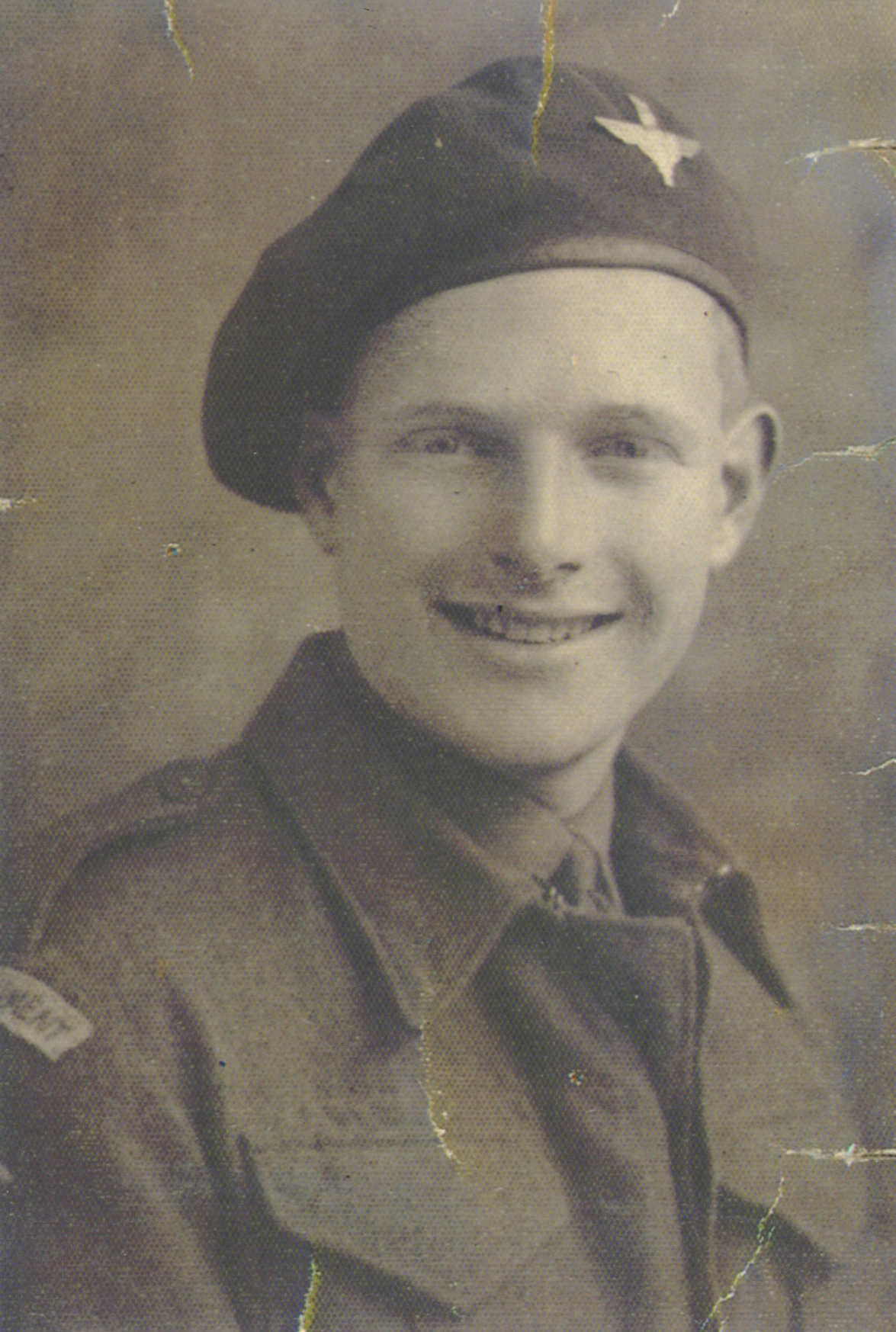 14417387 Pte John Jarvis Bosley was born on February 6, 1925 in
Westbury, Wiltshire.
14417387 Pte John Jarvis Bosley was born on February 6, 1925 in
Westbury, Wiltshire.
At the outbreak of the war in 1939, he was a schoolboy living in Salisbury, Wiltshire.
Prior to the joining The Parachute Regiment John had served in a young soldiers’ training Regiment in the Royal
Artillery.
He as learning all about vehicle anatomy and components, he had also learned to drive a motor vehicle, ride a
motor cycle,
operate a wireless set, fire a 25 pounder gun, and to operate in Morse Code.
Being keen on airplanes John
applied
to join the Para’s and soon he found himself doing the tough course at Hardwick Hall, where "they weed out the
men
from the boys".
After successfully completed the Hardwick Hall course he was sent to Ringway Airport near Manchester for
parachute
training. He was billeted in a small camp about a mile from the airport, consisting entirely of Nissen hutted.
He was put in a
squad of men with a Corporal “Nobby” Clarke of the Royal Air Force as their parachute instructor.
The
first week
was taken up by watching films of parachuting, ground training, learning to fall on thick mats, swinging in a
harness, exiting from high up fuselages of aircraft in a hangar then onto the fan from the roof of the hangar
and finally air experience in old Whitley bombers.
Then they went to Tatton Park and were issued with a
parachute. John was put in a stick of four and waited his turn to enter a small cage slung under a barrage
balloon. There was a big round hole in the floor of the cage and very little else to sit on:
- Up to about 800 feet swaying a little, scared stiff, John jumped.
- Next day another balloon jump
- On the third day John was put in a stick of ten men at the airport. They boarded a Whitley bomber and took off.
- Over the following days, he perfected the exit and the landings.
- On the penultimate day there was a night jump from the balloon at Tatton Park, which, in the black out, was pretty terrifying.
- Then two Dakota jumps, which he found a lot better than the Whitley,
- and the final jump with a kit bag attached on his right leg.
They were now trained parachutists and
awarded with their parachute wings by the Station Commander with an extra two shillings a day on their pay. This
made them feel very rich and a target for the girls. John was posted to the 11th Parachute Battalion and went to
a small Leicestershire village of Great Glen.
After being interviewed by the Commanding Officer
Lieutenant Colonel R.M.C.
Thomas, John was placed in the Intelligence Section.
After a while the battalion was moved to
Welby Lane Camp at
Melton Mowbray.
One of the men in his section he had met during his parachute training at Ringway. He was a
German Jew called
Gustav ‘Gus’ Sander, a very well-educated lad whose father had managed to get his family out
of Germany just prior to the outbreak of War in 1939. Gus and John became very good friends. Many exercises
followed and also German uniform recognition, checking maps and examining German weapons.
Early on June
6th,
1944 the Battalion was ordered on parade and told that the 6th Airborne Division had landed in Normandy. This
caused a stir as the men of the 11th regarded that their Division was much more experienced and would have been
better for
the job.
After being ready to depart for a military operation many times, the time had finally come. The
Battalion was told that the 1st Airborne Division and the 1st Polish Independent Parachute Brigade was to be
dropped in Holland to capture a bridge over the River Rhine. The Battalion was confined to camp and briefed
again, which was very limited. Everybody thought that this operation would be cancelled again and did not take
it too seriously.
However, when on Sunday September 17, 1944, they were paraded again and told that the first
lift had gone, they realised that they at last were going into action.
They were also told that there would be a
Church Service that evening if anyone wished to attend. John attended the Service in a small hut in the
barracks. The Service was conducted by the 11th Battalion Padre,
Reverend Henry Irwin, but only twelve men attended. There were hymns, prayers, the 23rd Psalm and a
Sermon. During the Sermon the Padre quoted from the
23rd Psalm. These words have stayed with John ever since and it made him think….
The next day, Monday
September
18, after breakfast, the Battalion boarded the lorries on the parade ground to be taken to the airfield.
As they left the gates of the camp at about 06:30 hours crowds of Melton townsfolk, girlfriends and wives were
seeing them off and waving farewell.
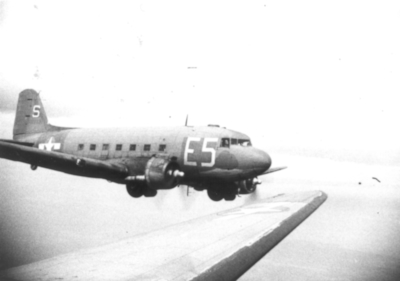 At Saltby airfield there were hundreds of American Dakota aircraft standing
all in line. John and his stick sat under the wing of their allotted aircraft drinking tea. Drinking tea was a
great mistake, as there were no loos in the Dakotas. They finally took off and were going to battle.
At Saltby airfield there were hundreds of American Dakota aircraft standing
all in line. John and his stick sat under the wing of their allotted aircraft drinking tea. Drinking tea was a
great mistake, as there were no loos in the Dakotas. They finally took off and were going to battle.
The flight to Holland was quite
uneventful until about twenty minutes before they reached the drop zone. Suddenly the aircraft started to rock
and weave and John heard explosions close by above the noise of the engines. He had great difficulty reaching
the door with the kit bag on his right leg, but the Royal Air Force dispatcher sent him out before he had time
to think twice.
John hit the ground heavily and started to head for the rendezvous point. He heard lots
of
bullets whizzing close by his head. John found his intelligence officer and Gus Sander, interrogating
a large group of German soldiers, dressed in camouflage smocks. John stayed on guard with Gus, who was speaking
to the prisoners in German and found that they were Waffen SS men.
On that moment the 11th Battalion's role
changed and they were to proceed to the Arnhem Bridge as quickly as possible. After numerous stops and starts
they finally got right down into Arnhem at midnight.
Around 04.00 hours on Tuesday morning 19th September the 11the Battalion moved
off again in columns each side of the road; slowly as the firing increased. As daylight broke all hell let
loose. About mid-day John was ordered by an Non Commissioned Officer to board a jeep
outside, expecting to go to the Bridge. To his surprise instead of heading towards the Bridge, he headed back in
the direction he had come from. They came to a halt in relative peace and quiet by a railway bridge in open
country.
The peace was soon shattered suddenly when a large group of German ME 109’s aircraft appeared overhead
strafing the area with bullets. John and his mates all scattered in different directions.
When all
became
quiet again John looked around; he was alone, miles out into enemy country.
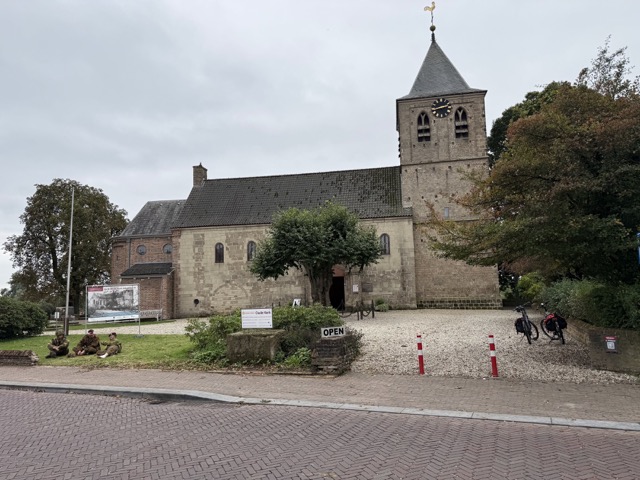 He made his way to
a small town
which turned out to be Oosterbeek where he found some of the 1st Airborne Division dug in around a small
church.
The next day John was sent out on patrol with a party from mixed units searching for tanks. The rest of
the day was spent dug in around the church. The following day John was picked up by
Regimental
Quartermaster
Sergeant (RQMS) Dave Morris of the 11th Battalion. With others from the unit they fortified a
house in
Weverstraat, just on the Arnhem side of the church. John and his comrades held this house all day against a
great deal of shelling and mortaring. RQMS Morris put John on guard for most of the night in the attic, keeping
a lookout for the Germans.
He made his way to
a small town
which turned out to be Oosterbeek where he found some of the 1st Airborne Division dug in around a small
church.
The next day John was sent out on patrol with a party from mixed units searching for tanks. The rest of
the day was spent dug in around the church. The following day John was picked up by
Regimental
Quartermaster
Sergeant (RQMS) Dave Morris of the 11th Battalion. With others from the unit they fortified a
house in
Weverstraat, just on the Arnhem side of the church. John and his comrades held this house all day against a
great deal of shelling and mortaring. RQMS Morris put John on guard for most of the night in the attic, keeping
a lookout for the Germans.
The following morning John’s own Sergeant ‘Rocky’ Knight came to the house and
ordered John to go with him. Sergeant Knight took along several others from John’s unit including
Private Harry
Liston. They patrolled and searched an area towards the railway line to Nijmegen, attracting a lot of
enemy
fire. In the afternoon ‘Rocky’ Knight again took them out on patrol to an area a few hundred yards west of the
church. John was not told what the purpose of their patrol was, but as they were going through some woods they
came under a terrific barrage of mortar bombs.
John felt a blow to his right leg. He sat down, rolled up his
right trouser leg and saw a neat round hole in the left side of his right calf; blood was pouring out at a fast
rate. Harry Liston saw John’s plight, came over to him and put a huge shell dressing around the wound in an
effort to stem the flow of blood. John also felt very damp and sticky under his left arm pit and put his right
hand into his smock. John withdrew his hand and found it covered in blood. He staggered back to the church
feeling very shaky and dazed. He asked a couple chaps to have a look at his back. Although his shirt, vest and
blouse were very bloodstained, one of the chaps said it was only a scratch and put a field dressing on it.
John
found his way to a nearby house still under heavy shelling and there he saw Major Lonsdale heavily bandaged who
said: “You better go next door Son”, which John did. He found it to be the Regimental Aid Post in the
church
vicarage, which was overflowing with wounded men. John found a place in a corridor where he was thankful to lie
down and placed his right leg in the air to stop the bleeding.
The next morning John found he could not
bend his knee. On investigating it he found a lump of shrapnel about two inches long embedded behind the back of
his knee cap. The Doctor and orderlies were still very busy, so John set about extracting the piece of shrapnel
himself.
Next day water had run out, so the Doctor asked for a volunteer to try to get to a pump in the
garden. John was dying for a drink and very hungry; no food since Monday, so he volunteered. In an outhouse John
found a walking stick and managed to get to the pump with a bucket. The effort completely exhausted him and he
passed out.
The next morning John was taken prisoner by the Germans. After being marched to Arnhem, he was
brought to Apeldoorn and was taken under guard to a nearby hospital where his wounds were checked and
dressed.
In early April 1945, after having been held captive in three different prisoner of war camps, John and all the
inmates of the prisoner of war camp were ordered to pack up and evacuate the camp. They were going to Southern
Bavaria to be held as
hostages.
Since John was unable to march he hid in the camp hospital. After the men had been marched away, he came out,
found four others and hid in a coal mine shaft. Four days later the Yanks arrived and John was free. He was down
to 8 stone (normally 12½), full of ulcers and boils, very weak, but still alive.
A week later John was home on double rations.
Immediately after the war John did a tour in Palestine.
After being discharged from the army John joined the police and later became a Police sergeant.
He died on October 3,
2022, at the age of 97.