4123427 Sergeant Anthony Bolland
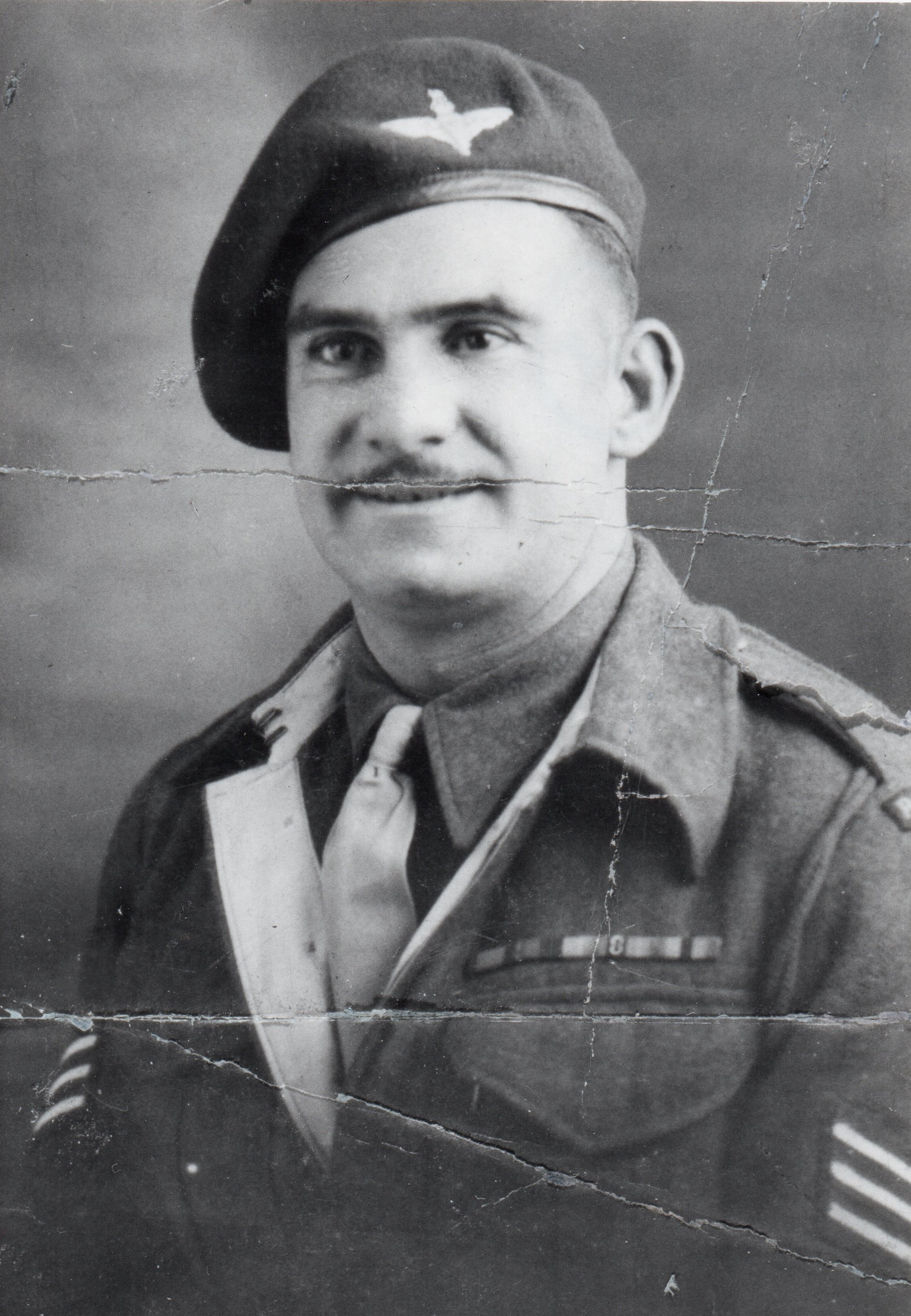 4123427 Sergeant Anthony Septimus Bolland was born on May 12th 1917 in Liverpool to parents Edward
and Lilly, the youngest of 7 children. Three days later, on May 20th, he was baptised into the Roman Catholic Church at the Church of Liverpool
St Joseph, as "Anthonius Septimus Bolland", his middle name clearly showing he was the seventh born
child.
4123427 Sergeant Anthony Septimus Bolland was born on May 12th 1917 in Liverpool to parents Edward
and Lilly, the youngest of 7 children. Three days later, on May 20th, he was baptised into the Roman Catholic Church at the Church of Liverpool
St Joseph, as "Anthonius Septimus Bolland", his middle name clearly showing he was the seventh born
child.
Two years later, in 1919 his younger brother was born, meaning there were now 10 people living in the Bolland
household.
Born into a poor working class family, in 1921 his father was an out of work dock labourer, who like
Tony's mother and siblings, was also born in Liverpool.
In 1933, aged just 16, Tony joined the Cheshire Regiment and was posted to India.
In 1939 this changed; along with thousands like him, Tony found himself in
North Africa fighting battles in the dessert.
In 1943 he volunteered for the Parachute Regiment and attended
parachute course 52 at Ramat David in Palestine from 05 until 17 July 1943.
After qualifying at the end of his parachute
course Tony was assigned to 7 Platoon, C Company, 11th Parachute Battalion.
On Monday September 18th 1944 he flew to Holland aboard a Dakota 42-100896.
Between the villages of Rhenen and Wageningen in Holland his aircraft was
shot down. Tony bailed out and was the last man to leave the rear of the aircraft.
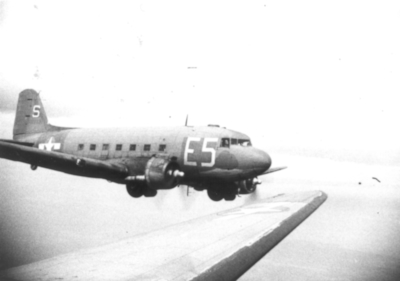 He landed near to the crashed
aircraft, but as his knee was injured, Tony was unable to move. Lance Corporal Alfred Smith joined Tony and
assisted him to a nearby ditch, where they discovered Private Leslie Thorne. The other two assisted Tony, and
went to the crashed aircraft, which was about 250 yards away. They discovered Private Edward James lying beside
the aircraft. He died shortly afterwards. They also saw Corporal Edwin Knowles and Private Cecil Page lying in the burning wreckage.
He landed near to the crashed
aircraft, but as his knee was injured, Tony was unable to move. Lance Corporal Alfred Smith joined Tony and
assisted him to a nearby ditch, where they discovered Private Leslie Thorne. The other two assisted Tony, and
went to the crashed aircraft, which was about 250 yards away. They discovered Private Edward James lying beside
the aircraft. He died shortly afterwards. They also saw Corporal Edwin Knowles and Private Cecil Page lying in the burning wreckage.
A few minutes later Dutch civilians showed up and informed them that Germans were
approaching from the city of Wageningen. These civilians then took the three British to a farm and hid them.
There Tony met Lieutenant Frederick Hale, USAAF, the pilot of the aircraft, and Private John Barratt. Lieutenant
Hale and Tony remained at the farm until the Germans set up a Flak battery nearby on 22 September 1944.
That evening they left the farm and walked north across country. After about two miles Tony and Hale were halted
by
German sentries. Lieutenant Hale dropped to the ground, but Tony was captured by the two Germans and taken to a
trench. Hale was not discovered.
Tony was then taken to the outskirts of the village of Bennekom, where he was
locked in a small room and left alone until about 06:00 hours on 24 September. During this time he was
not given any food, just a pitcher of water that had been left in the room. He was then given a
meal.
At 09:00 hours he removed the wooden slats covering the broken window of the room and climbed out of the
window. Tony then ran into a nearby wood and hid there for about two hours. During this time there was no sign
of any
search for him. He then walked through the wood and met a Dutch farmer who took him to a shed in a field. The
farmer gave him food and hid him in a bundle of hay.
News of Tony's disappearance reached
home and, in the October 13 1944 edition of The Liverpool Echo the following was printed:
"Sergeant
Anthony
Bolland, a parachutist was posted as missing in North-West Europe
on September 25. He is the son of Mrs. Bolland of 38 Alexander Pope Street, Liverpool 3 who will be grateful
for further information. He has had about 12 years' service in the Army, including several years in
India."
He remained there until the evening, when two members of
the underground movement came to the shed and took him to the farm where he had first stayed. Tony again met
Lieutenant Hale who had returned there. Lieutenant Hale and Tony remained there together until 13 October, when
they were taken to the village of Barneveld in a horse wagon bearing Red Cross markings. Tony and Lieutenant
Hale were disguised as wounded civilians.
On arrival at Barneveld they were taken to a house, where they stayed
until about 21 October. On the evening of that day they travelled by bicycle, escorted by a Dutchman to a wood
near the village of Renkum, where Tony and Lieutenant Hale met a large party of airborne troops. At this time,
they were part of the escape operation Pegasus I.
Overnight on 22–23 October 1944, Allied military forces,
Britain's MI9 intelligence organisation, and the Dutch Resistance evacuated 138 men, mostly soldiers trapped in
German-occupied territory who had been in hiding since the Battle of Arnhem a month earlier.
On October
23rd 1944 Tony arrived back in Allied territory.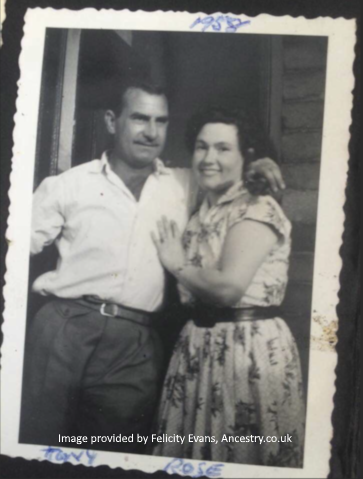 After the 11th Parachute Battalion was disbanded in November 1944, Tony joined the 1st Parachute Regiment and
was discharged on
28 November 1945. However, it was not until 28th November 1967 that he was awarded his 1939-45
Africa, France and Germany War medals.
After the 11th Parachute Battalion was disbanded in November 1944, Tony joined the 1st Parachute Regiment and
was discharged on
28 November 1945. However, it was not until 28th November 1967 that he was awarded his 1939-45
Africa, France and Germany War medals.
Following his discharge Tony remained in the Leicester area, and
in December 1946 married Rosina
Alice Fenn.
The two lived primarily in the Highfields area of Leicester, within walking distance of the city centre until
Tony died on 1st August 1990 at the age of 73. Rosina survived him until 2011.
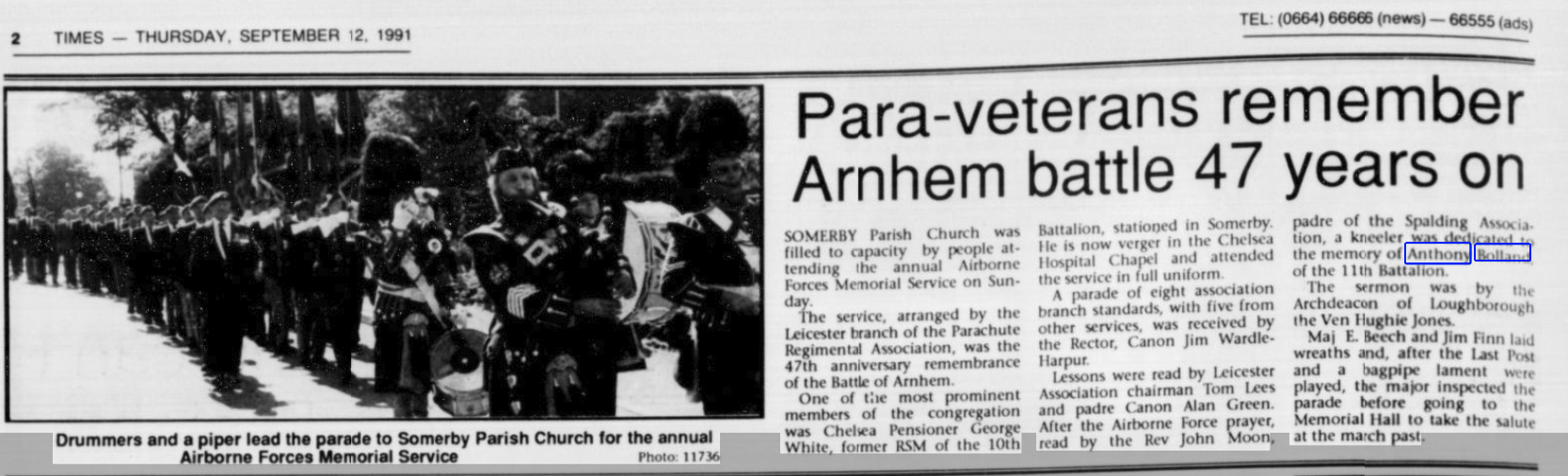
After his death Tony was not forgotten. At the annual Arnhem Forces Memorial Service held at Somerby on 12th September 1991, Tony was remembered by the dedication of a kneeler in his memory.